# Website Accessibility
Meet Accessibility and Language-Access Mandates Without Changing Official Records

CivicPlus
March 13, 2026
4 min
Accessibility and language access are no longer optional. They are legal requirements and community expectations.
With growing DOJ Title II enforcement and established WCAG standards, and California’s SB 707 amending the Brown Act, municipalities must ensure that public meeting agendas, packets, and supporting documents are accessible to residents who rely on assistive technologies. At the same time, expanding state-level language-access mandates require meeting information to be understandable for residents who speak languages other than English.
The Accessibility and Language-Access Challenge
For municipal clerks and administrators, meeting both expectations can be complex and time-intensive.
Agenda packets often include hundreds of pages of PDFs, attachments, and third-party documents. Making each one compatible with assistive technologies and aligned to WCAG standards is complex and time-consuming. Adding language-access requirements introduces another layer of coordination and risk.
Without built-in tools, clerks may rely on manual processes, informal translation tools, or external vendors. These approaches increase workload and introduce compliance risks. Portal-level translation alone is not enough when the underlying documents remain inaccessible.
The stakes are real. Inaccessible documents can exclude residents, erode public trust, and expose municipalities to legal and reputational risk.
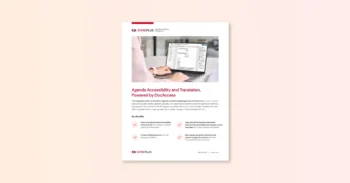
Introducing Agenda Accessibility and Translation Powered by DocAccess
CivicPlus Agenda and Meeting Management expands access with Agenda Accessibility and Translation, powered by DocAccess.
This integration automatically generates WCAG-aligned, screen reader–compatible HTML views of agenda packets, minutes, and supporting documents directly within the Public Portal.
These accessible document views can also be instantly translated into 250 languages. Municipalities can expand language access without creating or managing translated records. Original PDFs remain unchanged as the official record.
The result is a streamlined, defensible approach to improving accessibility and language access without disrupting existing workflows.
Tailored Benefits for Every Role
Whether you are preparing agendas, overseeing compliance, or managing organizational risk, this integration delivers measurable improvements.
For Municipal Clerks
- Provide accessible document views for all current and future agenda materials.
- Maintain existing workflows without creating new records or managing individual translations.
- Enable interactive “Ask a Question” capabilities to help staff and residents better understand dense or lengthy attachments.
For Administrators
- Strengthen readiness for DOJ Title II and WCAG and web accessibility standards.
- Reduce legal and reputational exposure tied to inaccessible public documents.
- Demonstrate a proactive, scalable approach to inclusive public meeting access.
Learn More about the Integration
Why It Matters
Public meetings are foundational to transparency and civic engagement. When agenda materials are inaccessible or difficult to understand, some residents are unintentionally excluded.
By aligning both portal interfaces and agenda documents to accessibility and language-access standards, municipalities can expand inclusive access while preserving official records. This reduces compliance risk and strengthens trust in local government.
Digital accessibility and language access are not separate initiatives. They are part of a broader commitment to serving every resident.
Tips to Get the Most Out of the New Features
Promote Multilingual Access Across Public Meetings
Highlight that agenda packets and supporting documents are available in 250+ languages. Making residents aware of translated document views encourages broader participation and demonstrates your commitment to inclusive access.
Communicate Expanded Access to Your Community
Let residents know that screen reader–compatible and translated document views are available. Increased awareness drives meaningful engagement.
Encourage Use of the “Ask a Question” Tool
Show staff and residents how conversational document engagement can help them navigate lengthy reports, technical materials, and supporting documents more efficiently.
Ready to Strengthen Accessibility and Language Access for Your Public Meetings?
Agenda and Meeting Management’s Agenda Accessibility and Translation, powered by DocAccess, helps municipalities meet document accessibility standards and language-access mandates without changing official records.
Connect with your CivicPlus representative to activate the integration and expand inclusive access to public meetings with confidence.
Written by
CivicPlus