# Public Safety
8 Tips for Local Government Community Emergency Preparedness
As emergency risks grow more complex, local governments play a central role in helping communities prepare, respond, and recover.

CivicPlus
February 12, 2026
10 min
Residents rely on local governments for clear guidance, reliable communication, and a coordinated response when emergencies occur. From severe weather and infrastructure failures to public health events and cybersecurity threats, preparedness is no longer limited to rare disasters. It is an ongoing responsibility that directly shapes public trust and community resilience.
Findings from the most recent CivicPlus Resident Satisfaction and Trust Report reinforce this point. Residents ranked emergency alerts as the single most desired feature in a municipal mobile app, cited by 56% of respondents. Emergency alerts, along with service disruption and event notifications, were also among the features most closely associated with higher trust in local leadership and perceptions of reliability.
To support this critical role, this guide outlines eight practical tips local governments can use to strengthen community emergency preparedness, improve coordination, and support resident access to timely, actionable information before, during, and after an emergency.
What Is Community Emergency Preparedness?
Community emergency preparedness refers to coordinated, community-wide efforts that equip residents with the information, resources, and support needed to prepare for potential emergencies. These efforts operate at both the individual and collective level, helping people understand risks, plan ahead, and respond effectively when incidents occur.
Recent findings from the National Preparedness Report highlight a persistent gap between perceived and actual preparedness. Many individuals believe they are ready for emergencies even when critical plans, supplies, or communication channels are missing, while others have taken no preparatory steps at all. Only about half of Americans (51%) say they feel prepared for a disaster.
At the same time, participation in basic preparedness actions is uneven. Notably, the percentage of people signed up for alerts and warnings dropped sharply, from 46% in 2022 to 36% in 2023.
Additional data from the Risk and Reliance Hub reinforces this disconnect: Only 50% of people believe that taking steps to prepare would actually help them get through a disaster.
Access to timely, reliable information plays a significant role in shaping how prepared residents feel. When clear, real-time updates are unavailable, confidence in the ability to respond declines, even among individuals who believe preparedness is important.
The Role of Local Government: Addressing the Preparedness Gap
Local governments play a key role in closing that gap through education, planning, and accessible communication systems that support coordinated response across a range of modern risks, from cyberattacks to chemical spills. These efforts help residents understand what to expect, where to turn, and how to act when emergencies occur.
Preliminary findings from upcoming CivicPlus research suggest that investment in mass notification systems is emerging as a top priority for local governments. In this research, mass notification systems ranked as the most desired government technology investment, cited by approximately 53% of respondents, ahead of city websites (51%) and website accessibility (50%). These early insights will be published in a forthcoming report.
Programs such as Community Emergency Response Teams (CERTs) and related preparedness initiatives further support this work by equipping residents with shared expectations, consistent information, and clearer pathways for participation during emergencies.
Encouraging residents to sign up for alerts and warnings remains a direct and effective action local governments can take to strengthen preparedness, improve coordination, and build confidence in emergency response efforts.
The Challenge for Local Government
Local governments face growing pressure to prepare for emergencies with limited resources. Staffing shortages, constrained budgets, and aging or fragmented technology can make it difficult to sustain preparedness efforts, even as the frequency and complexity of emergencies continue to increase. Emergency incidents now require faster coordination and broader readiness than in the past.
At the same time, residents expect timely, reliable communication when emergencies occur. Meeting those expectations requires clear plans, inclusive preparedness strategies, and communication systems that can deliver critical information quickly across multiple channels to residents, including those with disabilities.
Balancing these demands means local governments must prioritize tools and processes that support coordinated response, reduce operational strain, and help residents receive accurate information when it matters most.
Understand the Four Phases of Emergency Management
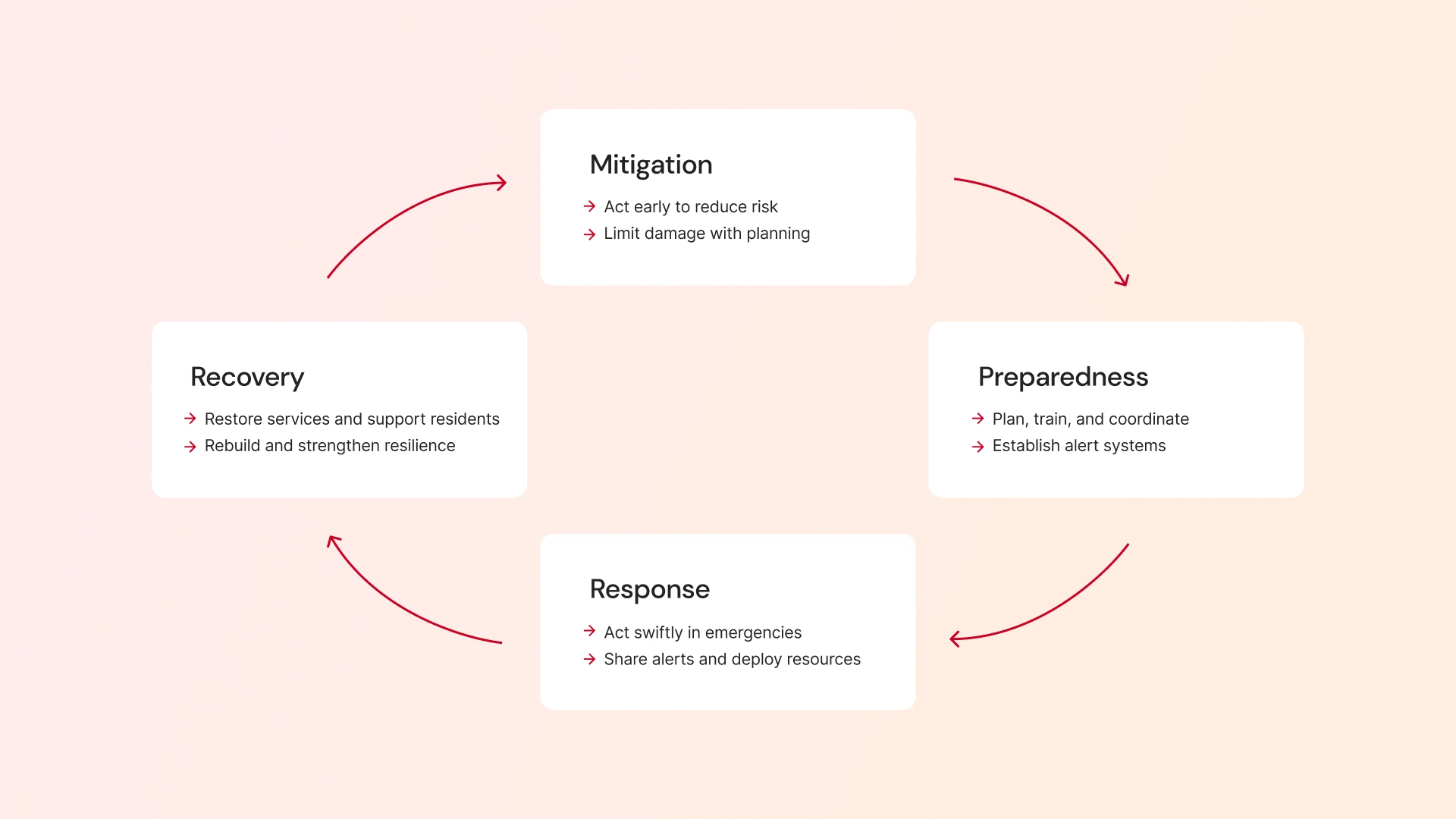
Emergency preparedness is one component of a broader emergency management cycle that guides how communities plan for, respond to, and recover from disruptive events. This cycle helps local governments move from reactive response to coordinated, long-term resilience. It includes four interconnected phases:
Phase 1: Mitigation
Efforts taken in advance to reduce risk and limit potential damage, such as land-use planning, floodplain management, building codes, infrastructure improvements, and mitigation strategies informed by local conditions and resident knowledge.
Phase 2: Preparedness
Ongoing planning, training, and coordination help prepare people and systems for emergencies. This includes emergency operations planning, interagency coordination, drills, and establishing reliable communication and notification processes.
Phase 3: Response
Immediate actions taken during and shortly after an emergency to protect lives and property. These actions often depend on timely information sharing, emergency alerts, and coordinated deployment of personnel and resources.
Phase 4: Recovery
Longer-term efforts focused on restoring essential services, rebuilding infrastructure, and supporting residents as communities return to normal operations and strengthen resilience for future events. This phase may also include a public community debrief that explains what occurred, how response decisions were made, and what resources were used. It can also provide updates on impacts to people, property, and infrastructure, while recognizing emergency responders, staff, volunteers, and community members who supported response and recovery efforts.
Understanding how these four event phases work together allows local governments to create comprehensive emergency strategies that extend beyond short-term response and support sustained preparedness, clear communication, and community trust over time.
Many local governments publicly outline this framework on their municipal websites to help residents understand how emergency planning and response work together in practice.
Eight Tips for Your Emergency Management Plans
Tip #1. Partner with Local and Private-Sector Resources
Effective emergency preparedness depends on strong partnerships across the community. In addition to emergency response agencies, local governments should engage utilities, healthcare providers, school districts, nonprofit organizations, and private-sector partners that support critical services or communications. Formalizing these relationships in advance helps clarify roles, improve coordination, and reduce delays when emergencies occur.
Tip #2. Recruit Residents for Participation
Effective community preparedness depends on resident involvement that is both broad and well-organized. Local governments should use a mix of traditional and digital outreach methods to recruit residents to participate in preparedness efforts, including CERTs, as well as to identify residents, property owners, and facilities that may serve as local response resources during emergencies.
Digital channels such as social media, municipal websites, email newsletters, and online sign-up forms help expand reach by enabling residents to opt in to mass notification systems, register skills, equipment, or facilities, reducing barriers to participation.
Recruitment efforts should extend beyond volunteers and donations alone. Many residents and property owners can support emergency response by offering facilities, equipment, or specialized capabilities. These may include buildings that can serve as shelters, staging areas, or rest sites for crews, and privately owned equipment that could assist response efforts if identified in advance. Engaging emergency responders, leaders of community organizations, healthcare partners, and other local stakeholders helps create a more resilient and adaptable response network. Encouraging cross-training better positions staff and volunteers to support multiple roles as conditions and threats evolve.
Additionally, maintaining a centralized list of available facilities, equipment, and resident capabilities within the emergency operations center (EOC) helps reduce delays during incidents and avoids time-consuming coordination when conditions are most urgent.
Providing access to established CERT training resources helps standardize skills, build confidence, and prepare participants to assist effectively when emergencies occur, including in non-physical support roles such as communications, logistics, or basic operational support.
Tip #3. Schedule Regular Group Meetings
Once residents are recruited to participate in emergency preparedness efforts, local governments should establish a regular meeting cadence to initiate planning and keep it active and inclusive over time. Meetings should be open to new participants and designed to move preparedness efforts forward, starting with the development and review of a clear, actionable emergency preparedness plan.
To increase participation and accessibility, communities should consider offering hybrid or virtual meeting options, not just in-person sessions. Flexible formats make it easier for residents with busy schedules, mobility limitations, or transportation barriers to stay involved.
Sharing meeting agendas, draft plans, or discussion topics in advance can also help keep sessions focused and productive. When residents understand expectations and priorities ahead of time, meetings are more likely to result in meaningful input, stronger alignment, and sustained engagement across the community.
Regular meetings can also be used to ensure continuity of emergency operations by familiarizing elected officials and key staff with emergency protocols, including how to initiate emergency operations and activate the emergency operations center (EOC) when needed, as well as how to access and use core digital systems such as mass notification tools, emergency dashboards, and communication platforms during an event. Maintaining shared awareness of roles, access procedures, and escalation steps helps reduce delays and supports faster, more coordinated response during time-sensitive events.
Tip #4. Identify Community Members with Special Needs
Effective emergency preparedness requires proactive planning for residents who may need additional support during an emergency, including:
- Older adults
- Children
- People with disabilities
- Individuals with access or functional needs
Local governments should combine data-informed planning with targeted outreach to understand where support may be needed. This includes coordinating with senior centers, assisted living facilities, schools, daycare providers, and disability service organizations, as well as working closely with local health and human services departments. This approach also supports ADA requirements and inclusive communication best practices, helping critical information reach more residents during emergencies.
Digital outreach campaigns, community workshops, and partnerships with trusted local organizations can help preparedness information reach residents who may not engage through traditional channels.
Building these relationships in advance supports clearer evacuation planning, continuity of medical care, accessible sheltering, and reliable communication during emergencies, while also strengthening trust and participation across the community.
Tip #5. Educate Residents on Individual Home Preparedness
Clear, practical guidance helps residents take action before emergencies occur.
Local governments can support this by sharing trusted preparedness resources and checklists that outline essential steps for home safety, such as assembling emergency kits, maintaining smoke and carbon monoxide detectors, and knowing how to shut off utilities.
National resources like Ready.gov provide proven templates and educational materials that local governments can adapt for their communities. Publishing this information on the local government website and promoting it through digital channels makes preparedness guidance easy to find, understand, and act on.
Tip #6. Implement an Emergency Notification System
An effective emergency preparedness strategy depends on timely, reliable communication. To help critical information reach residents quickly, local governments should implement a mass notification system that supports multi-channel alerts, including:
- Text alerts
- Email alerts
- Mobile app notifications
- Social media alerts
- Website updates
The system should integrate with FEMA’s Integrated Public Alert and Warning System (IPAWS) to extend reach beyond opted-in users when necessary.
Tip #7. Encourage Signups for the Emergency Communication and Notification System
An emergency notification system is only effective if residents are enrolled. Local governments should use multiple touchpoints to promote signups, including their website, social media, utility bills, public signage, and community events.
QR codes can make enrollment quick and accessible, especially when paired with clear messaging about the value of timely alerts.
Letting residents know that alerts can be personalized also encourages signups by giving them more control over the types of messages they receive, how often they are contacted, and which channels they prefer, reducing information overload while keeping critical alerts front and center.
Ultimately, removing friction and meeting residents where they already are helps increase participation and improves the likelihood that messages reach the people who need them most.
Tip #8. Establish and Communicate Evacuation Procedures
Effective evacuation planning depends on advance preparation and consistent communication that residents can understand and act on quickly.
Local governments should define evacuation routes, shelter locations, and decision-making thresholds in advance and make that information easy for residents to find. Posting evacuation maps and procedures on the local government website, updating them regularly, and reinforcing them through emergency notifications helps residents act quickly when conditions change.
During an active incident, evacuation guidance should be delivered through multiple channels, including text alerts, email, website alerts, and mobile notifications. Clear, concise instructions play an important role in reducing confusion and limiting avoidable inquiries during response operations.
Take the Next Step in Emergency Preparedness
Strong emergency preparedness is built through consistent planning, coordinated communication, and systems that support residents before, during, and after an incident. Local governments that invest in clear processes, accessible information, and reliable communication channels, including mass notification systems, are better positioned to respond quickly, reduce confusion, and support coordinated response when conditions change.
Modern emergency communication tools are a core part of that readiness. From sharing evacuation guidance and shelter information to delivering time-sensitive alerts across multiple channels, integrated systems help ensure residents receive accurate information when it matters most.
Improve Your Emergency Response Strategy with CivicPlus
Ready to see how CivicPlus® can support your emergency communication strategy?
Take a self-guided virtual tour of our Mass Notification solution and discover how easy it is to keep your community connected when it matters most.
Written by
CivicPlus